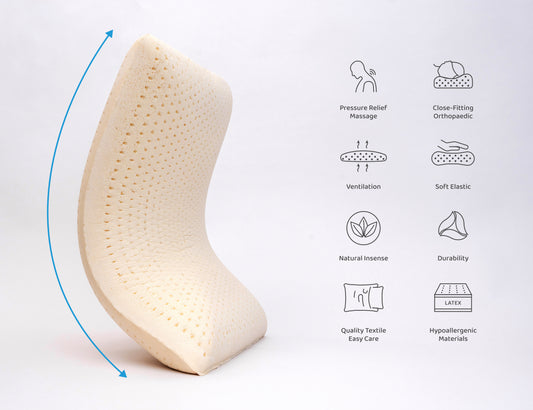

If you often wake up with a stiff neck or a heavy head, it’s not necessarily about how many hours you sleep — it’s about how you sleep. The alignment of your neck and spine during the night is one of the most overlooked foundations of true rest.
The cervical spine — the delicate structure of vertebrae, muscles, and nerves that supports your head — is designed to maintain a gentle natural curve. When that curve collapses because the pillow is too high, too soft, or too flat, the surrounding muscles tense up to compensate. This tension can limit blood flow, irritate nerves, and trigger morning headaches or shoulder pain. Over time, poor sleep posture can even affect breathing efficiency and oxygenation during rest.
Scientists who study sleep biomechanics emphasize that optimal neck alignment allows the brain to enter deeper, more restorative stages of sleep. When the head is properly supported, the body’s stress response quiets, heart rate lowers, and micro-awakenings — those tiny, unnoticed interruptions in sleep — become less frequent.
Natural latex pillows are particularly effective at maintaining this alignment because of their elastic resilience. The material gently yields where pressure is applied and lifts where support is needed. It adapts instantly to your movements without losing shape, unlike synthetic foams that often compress over time. Latex’s responsive structure keeps the neck balanced whether you sleep on your back, side, or somewhere in between.
The result is subtle but powerful: fewer pressure points, relaxed neck muscles, and a sense of genuine freshness when you wake. Good posture isn’t only a daytime concern — it’s a nighttime necessity. Supporting the natural line of your spine while you sleep can be one of the simplest ways to feel more awake, focused, and calm the next day.